 Back
Why integrating ERP, PIM and CRM requires more than exchanging information.
An industrial customer logs into a purchasing portal, selects a product, checks the price and confirms an order.
On the surface, the process looks straightforward. But what happens if the portal displays one price while the ERP holds another? What if inventory changes while the customer is preparing the order?
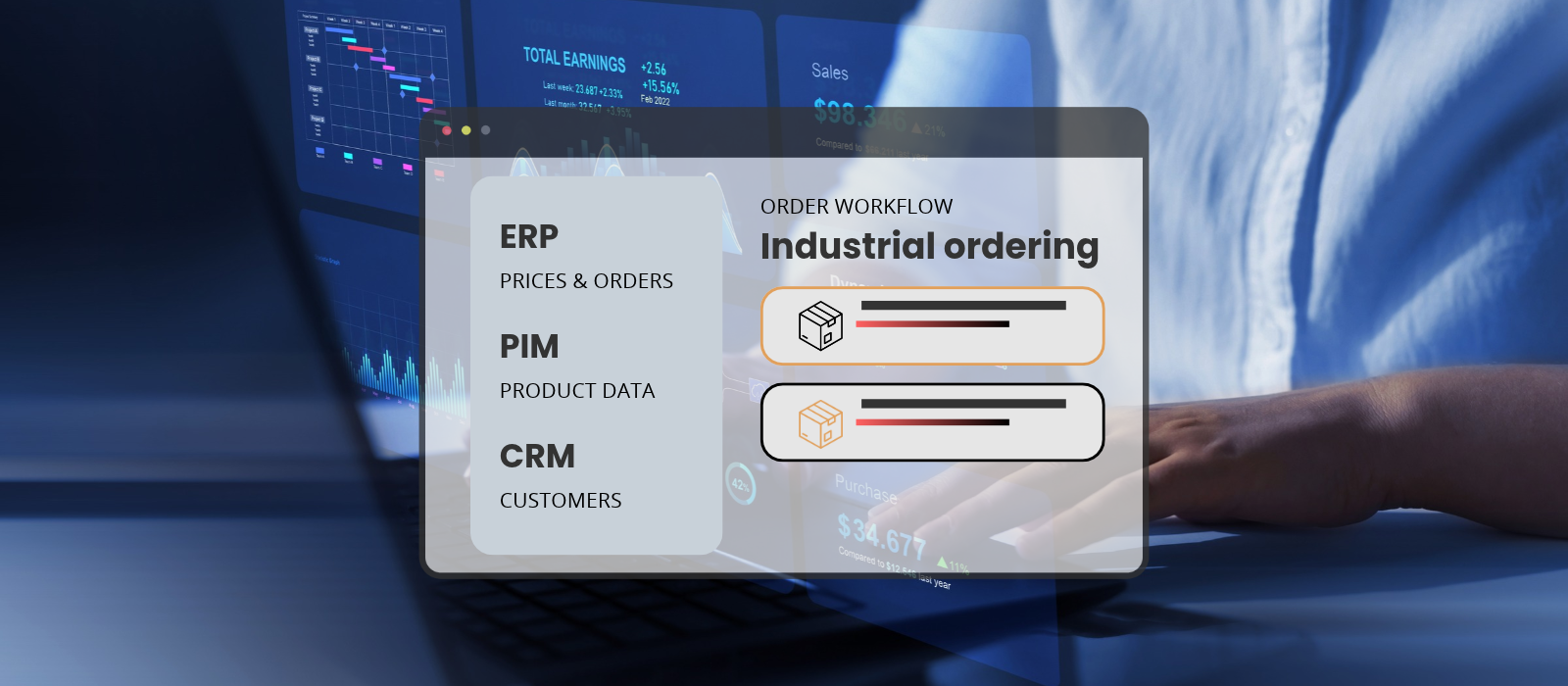
Behind a seemingly simple transaction, several enterprise systems may be involved. The ERP manages operational and commercial information. The PIM organizes product data. The CRM maintains customer relationships. Identity management systems control access to different services.
The real challenge of B2B commerce is not simply connecting these systems. It is ensuring they work with consistent information and correctly apply the company’s business rules.
Achieving this requires four important architectural decisions.
1. Establish a source of truth for each data domain
When multiple systems manage related information, it is essential to define which system provides the authoritative data for each area.
For example:
- ERP: may serve as the source of truth for contracted prices, inventory, sales conditions and orders.
- PIM: may centralize product attributes, descriptions and commercial documentation.
- CRM: may manage customer relationship information and commercial interactions.
- Identity management: determines how users are authenticated and which permissions they have.
The exact responsibilities depend on each company’s architecture and processes. There is no universal model.
Without clear ownership, connecting more applications can introduce inconsistencies rather than eliminate them.
2. Separate data from business rules
Displaying a price is not the same as calculating the correct amount a customer should pay.
Industrial B2B transactions may involve contractual terms, volume discounts, minimum order quantities, packaging multiples, credit limits or country-specific sales restrictions.
These rules should not be scattered across applications without a clearly defined approach.
Before implementing integrations, three questions matter:
- Where is each commercial condition calculated or validated?
- Who is responsible for maintaining it?
- How does the portal ensure the correct rules are applied to each customer?
A well-designed architecture makes purchasing easier without oversimplifying the business logic behind the transaction.
3. Decide which information needs to be up to date immediately
Not every data element requires real-time synchronization.
Product descriptions and certain marketing materials can often be updated through scheduled processes.
However, product availability, applicable pricing and order validation may require more recent information, particularly before an order is confirmed.
The right approach depends on how long information can remain outdated without affecting the business process.
Instead of asking only whether two systems can be connected, ask:
When does the customer need this information, and what happens if it is outdated?
The answer helps determine which processes require immediate updates, which can be handled asynchronously and which checks must be repeated before accepting an order.
4. Design for exceptions, not just successful transactions
Integrations need to work when everything goes as expected. But they also need to handle situations where something goes wrong.
Consider these scenarios:
- The ERP becomes unavailable during order confirmation.
- The received price does not match the customer’s contracted conditions.
- A product is no longer available.
- An automated process fails and needs to be retried.
The platform needs mechanisms to detect incidents, log errors, retry operations without creating duplicates and allow human intervention when necessary.
Completing a successful transaction matters. Knowing what to do when a transaction cannot be completed is equally important.
Five questions to review your B2B commerce architecture
Before adding new functionality, consider:
- Which system is the authoritative source for each critical data element?
- Where are prices, restrictions and commercial conditions calculated?
- Which information needs immediate updates?
- How are discrepancies between systems detected and resolved?
- What does the customer see when a validation cannot be completed?
Answering these questions can help identify architectural weaknesses before they turn into operational issues.
From technical integration to business value
At insinno, we develop B2B commerce solutions connected to existing enterprise systems.
One example is our work with BTC Europe, where we developed an SAP-integrated ordering solution that makes it easier to access product information, pricing and ordering capabilities through mobile devices.
Explore the BTC Europe success story.
Projects like this illustrate why the value of B2B commerce extends far beyond having an online storefront: the goal is to connect the purchasing experience with the business processes that make every transaction possible.
Before investing in another feature, there is one question worth asking:
What business decision must our platform get right for an order to be completed?
If your company is reviewing its B2B commerce platform or looking to improve integration across its commercial systems, let’s talk.