 Back
Imagine a business customer ordering specialized industrial products through an online platform. The price is correct, the stock is available, and the order is placed within seconds.
But what happens if the customer receives an outdated Safety Data Sheet? What if important technical specifications are missing? Or if the product is classified as dangerous goods and the transport requirements have not been properly considered?
In industrial B2B e-commerce, a successful purchase involves much more than completing an online transaction.
For manufacturers and distributors, regulatory compliance, product documentation and logistics are essential parts of the purchasing process. And when these elements are managed through disconnected systems, even a simple order can become unnecessarily complex.
Why regulatory compliance matters in B2B e-commerce
Unlike conventional online retail, industrial commerce often involves products with specific technical, safety and transportation requirements.
This is particularly relevant for manufacturers, industrial distributors, suppliers of specialized materials and businesses operating across multiple markets.
Customers do not simply need to know whether a product is available. They may also need to understand how it should be handled, whether it is suitable for a particular application, and which conditions apply to its delivery.
For companies selling across multiple countries, the challenge becomes even greater. Product documentation, language requirements and transportation conditions can vary depending on the market and product classification.
The question is therefore not simply whether a company can sell its products online, but whether its digital processes can support the requirements that come with each transaction.
Safety Data Sheets (SDS): more than a downloadable PDF
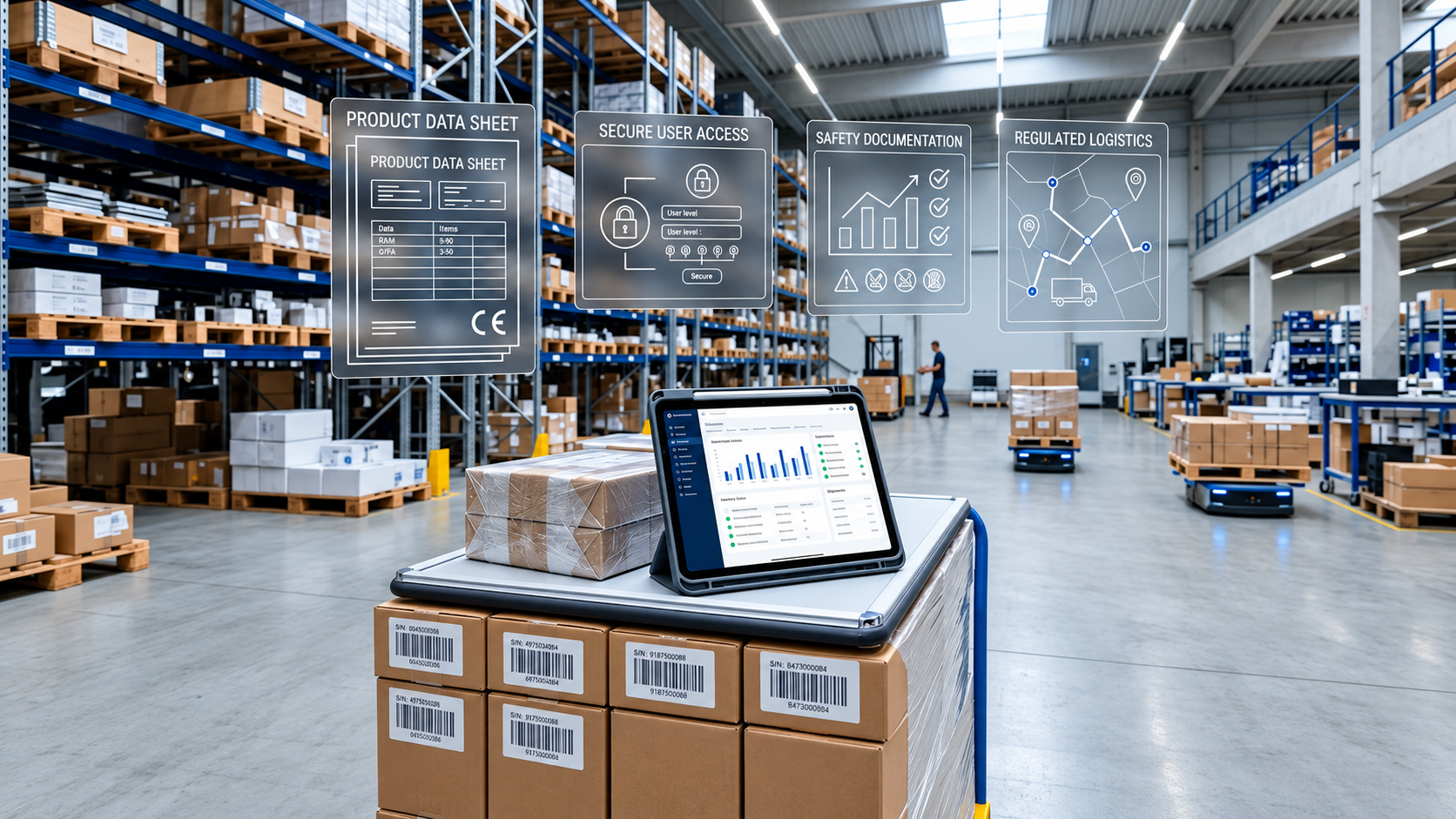
For products subject to specific safety requirements, Safety Data Sheets (SDS) are an essential part of regulatory compliance.
Under the European REACH Regulation, suppliers must provide SDS for substances and mixtures when the applicable legal conditions are met. These documents contain important information about hazards, safe handling, storage, exposure controls, emergency measures and transportation.
They must also meet specific content requirements, be provided in the appropriate language and be updated when relevant new safety information or regulatory changes require it.
For companies operating an industrial e-commerce platform, this creates an important challenge.
What happens when a product’s SDS is updated, but the online shop still provides the previous version? Or when a customer in another country receives documentation in the wrong language?
Simply uploading documents to a website is not enough to manage these responsibilities reliably.
A well-designed B2B platform should connect products with the correct documentation, manage document versions and support the required delivery of updated safety information.
An integrated document center can make it easier for customers to find and download the information they need. However, where regulations require an SDS to be supplied directly to a recipient, making it available for download alone does not replace that obligation.
The objective is to reduce manual searches, prevent outdated information from circulating and ensure that documentation remains connected to the products being sold.
Product Data Sheets (PDS): choosing the right product requires the right information
Regulatory safety information is only one part of the equation.
Industrial buyers also depend on accurate technical specifications to determine whether a product is suitable for their intended application.
Product Data Sheets (PDS) can provide information such as material properties, application guidelines, compatibility requirements, temperature limits or technical performance characteristics.
Unlike SDS, PDS are not subject to one universal legal requirement across all product categories. However, accurate technical documentation remains important for product selection, operational reliability and compliance with any applicable product-specific requirements.
Consider a customer ordering specialized industrial equipment or construction materials. An incorrect specification could lead to the wrong product being selected, potentially causing delays, additional costs or problems during its application or use.
In this context, technical documentation should not be treated as separate from the purchasing experience.
Connecting a Product Information Management (PIM) system with the online catalog can help companies maintain consistent specifications and documentation across products, languages and sales channels.
Document access: providing the right information to the right users
Making product documentation available online does not necessarily mean that every document should be accessible to everyone.
In B2B environments, different users may require different levels of access depending on their role, company, contractual relationship or authorization.
For example, general product brochures and standard technical specifications may be publicly available, while customer-specific documentation, restricted technical manuals or confidential product information may require authentication.
An integrated B2B platform can manage document downloads through user permissions, ensuring that customers and business partners can access the information they are authorized to view.
This can include:
- Public access to general product information and documentation.
- Protected downloads for registered customers or authorized business partners.
- Role-based access to specific technical documents.
- Centralized management of document versions and updates.
- Traceability of document access and downloads where appropriate.
These controls help companies protect sensitive information while improving the customer experience.
At the same time, access restrictions must be designed around the applicable legal obligations. For example, mandatory safety documentation must still be provided to recipients in accordance with the relevant regulations.
The objective is to make documentation easily accessible to the right people, while maintaining security, consistency and control.
ADR logistics: compliance does not end when the customer places an order
For products classified as dangerous goods, the requirements extend beyond documentation and product selection.
The Agreement concerning the International Carriage of Dangerous Goods by Road (ADR) establishes requirements for the safe transportation of dangerous goods, including classification, packaging, marking, documentation and transport operations.
The ADR 2025 edition is currently applicable, while UNECE has also published amendments intended for the 2027 edition.
For industrial manufacturers and distributors, this means logistics processes must account for the relevant dangerous-goods requirements.
Depending on the product and shipment, these may include:
- The correct UN number and transport hazard classification.
- Applicable packaging and marking requirements.
- Shipment quantities and relevant exemptions.
- Required transport documentation and carrier conditions.
An industrial e-commerce platform should therefore be able to exchange the necessary product and shipment information with logistics and warehouse systems.
A product being available for purchase does not automatically mean it can be transported under every requested delivery condition.
That distinction matters. Checking the relevant transport requirements before a shipment is released can help prevent avoidable delays and operational problems.
The real challenge: connecting e-commerce, documentation and enterprise systems
Many businesses already have the information they need. The problem is that it is distributed across different departments and applications.
Product specifications may be stored in a PIM system, customer-specific conditions in an ERP, safety documents in a separate repository and transport information within logistics software.
When these systems are not properly connected, employees may need to collect information manually, verify documents, manage access permissions and resolve exceptions after an order has already been placed.
An integrated B2B e-commerce environment can improve this process by connecting the online platform with the underlying business systems.
For example, it can support:
- Access to the appropriate SDS and PDS for each product and market.
- Consistent product information across sales channels.
- Secure document downloads based on user roles and access rights.
- Exchange of relevant dangerous-goods data with logistics systems.
- Traceability of document versions, updates and order-related information.
Of course, technology supports regulatory compliance; it does not replace the specialist assessment needed to interpret and apply legal requirements.
The objective is to make the correct information available to authorized users at the right point in the process, while maintaining the necessary controls.
From fragmented documentation to reliable product information: the BTC Europe use case
At insinno, our experience with industrial B2B commerce demonstrates the importance of connecting product information, technical documentation and existing enterprise systems.
A practical example is our work with BTC Europe, where customers need access to product specification sheets and document downloads alongside up-to-date product and commercial information.
In this environment, managing product documentation is an essential part of providing an efficient digital customer experience.
The BTC Chemshop solution was developed to meet these requirements, connecting product information with existing enterprise systems, including SAP.
This enables product specifications and relevant information to be retrieved through connected digital processes, reducing the need to search across disconnected systems.
The importance of this approach goes beyond the purchasing transaction itself.
Customers need reliable access to the technical information associated with the products they use, and businesses need a structured way to manage that information.
For similar B2B environments, combining centralized documentation with appropriate user permissions can also ensure that general product information remains easily accessible while restricted documents are protected.
Discover the BTC Europe project.
This illustrates a broader principle: effective industrial e-commerce depends on connecting the customer-facing experience with product information, technical documentation and enterprise processes.
The same principle applies to regulatory documentation and logistics. They should be considered when designing the overall process, rather than treated as isolated activities after checkout.
Conclusion: Safe-Commerce starts before checkout
For industrial companies, e-commerce is not simply about making products available online. It is about enabling reliable transactions while addressing technical, regulatory and operational requirements.
Safety Data Sheets, Product Data Sheets and ADR logistics each play a different role, but they share one important characteristic: their information must be accurate, accessible and connected to the relevant business processes.
At the same time, not every document needs to be available to every user. Managing access rights and protected downloads is another important aspect of building reliable B2B platforms.
As industrial commerce becomes increasingly digital, integrating these requirements into existing systems can help companies reduce manual work, improve transparency, protect sensitive information and strengthen customer confidence.
The real question is no longer just whether customers can order your products online, but whether your entire organization is prepared to provide the right information, to the right users, at the right time, while processing those orders safely, efficiently and in line with applicable requirements.
That is where Safe-Commerce begins.