
 Back
Back Imagine that a potential customer visits your company’s website to check a product’s technical specifications. They’re convinced and decide to buy it. In the traditional scenario, one of two things happens: either the customer has to leave your website to go to a completely different shopping portal, or they’re met with a static page that simply says ‘call us for a quote’.
In the past, the industry standard was to take things step by step: first, a corporate website was built to showcase the brand, and years later, thoughts turned to how to sell online. The result was often a headache: separate systems that don’t communicate with one another, or a fear of launching an online shop because of uncertainty about how to integrate it with the existing website.
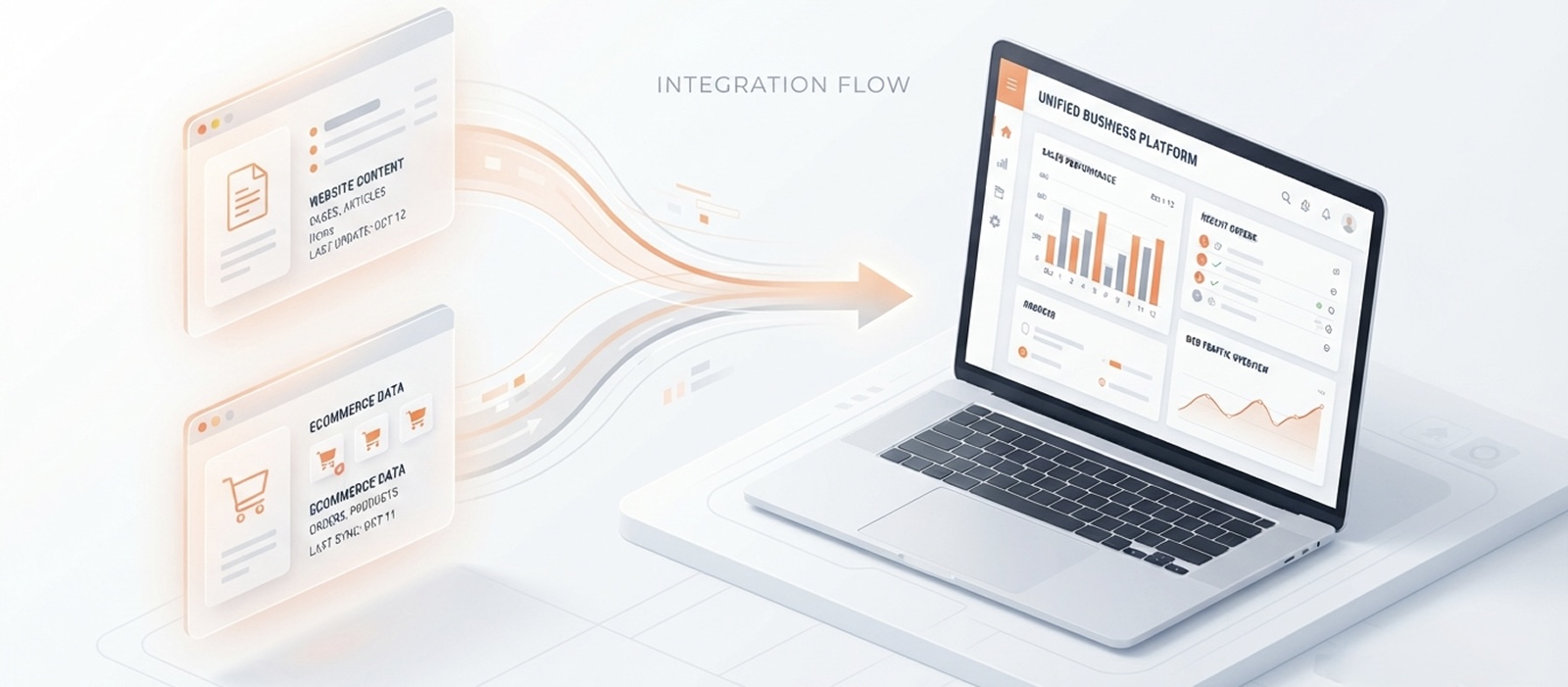
Nowadays, technology makes it easy for both your customers and your team. True digital success lies in bringing your company’s content and online sales together under one roof.
It doesn’t matter where you’re starting from
To take this step towards efficiency, you don’t need a perfect technological infrastructure. In the industrial sector, we mainly encounter two situations, and both have a solution:
- Scenario A (You already have both systems, but they’re separate): You have your website on one side and an online shop on the other. Your customers get confused by so many passwords, and your team has to work twice as hard, duplicating data. The solution? We connect and unify both information flows so they function as one.
- Scenario B (You have a corporate website, but NO online shop): Your current website works well for showcasing who you are, but you want to start selling online or automate repeat orders. The solution? We build your e-commerce platform from scratch and integrate it natively into your existing website. You don’t have to change your website; we’ll evolve it.
Why is the unified model the new standard?
When corporate information (catalogues, manuals, quality certificates) coexists in the same place as the shopping gateway, your business immediately gains a competitive edge for three reasons:
1. Say goodbye to duplication of effort and errors
With a single database, any changes you make to a technical data sheet or the catalogue are instantly reflected in both the information section and the shop. Your team is freed from repetitive tasks and can ensure that prices and stock levels are always correct.
2. The customer has everything at their fingertips (Single control panel)
For the industrial buyer, the experience becomes incredibly straightforward. The customer visits your website, logs in and accesses a personalised control panel. From that single screen, they can:
3. Direct connection to your office and warehouse
- View technical or safety documents for a material.
- Check the status of their orders in real time or download invoices.
- Reorder a regular order with just two clicks, seeing their special rates already applied.
Whether it’s a new shop or an integrated one, the system connects directly to your company’s management software (your ERP). This means that when a customer clicks on the website, the warehouse receives the notification, stock is automatically deducted and the invoice is generated automatically.
Conclusion: Less complexity, greater efficiency
Making complex processes seem simple is the surest way to win your customers’ trust and improve your team’s performance.
Don’t let the lack of an online shop or the confusion of having separate systems hold back your business’s growth. Taking the step towards data unification is the direct route to transforming your website into a strategic asset that works and sells for you 24 hours a day.